Tuesday, July 24, 2012

Wednesday, July 18, 2012

are rich people evil? Starting to think so

After finding out that the powers that be want a trade imbalance with China because it keeps the wages low for american companies to pay Chinese workers I am starting to think that all rich people are evil or a significant amount of them.

Monday, June 11, 2012

Paul Ryan believes that altruism does not exist or is impossible


  • "I just want to speak to you a little bit about Ayn Rand and what she meant to me in my life and [in] the fight we’re engaged here in Congress. I grew up on Ayn Rand, that’s what I tell people."
  • "I grew up reading Ayn Rand and it taught me quite a bit about who I am and what my value systems are, and what my beliefs are."
  • "It’s inspired me so much that it’s required reading in my office for all my interns and my staff. We start with Atlas Shrugged. People tell me I need to start with The Fountainhead then go toAtlas Shrugged [laughter]. There’s a big debate about that. We go to Fountainhead, but then we move on, and we require Mises and Hayek as well."
  • "But the reason I got involved in public service, by and large, if I had to credit one thinker, one person, it would be Ayn Rand."
  • "And when you look at the twentieth-century experiment with collectivism—that Ayn Rand, more than anybody else, did such a good job of articulating the pitfalls of statism and collectivism—you can’t find another thinker or writer who did a better job of describing and laying out the moral case for capitalism than Ayn Rand."
  • "It’s so important that we go back to our roots to look at Ayn Rand’s vision, her writings, to see what our girding, under-grounding [sic] principles are."

  • "Because there is no better place to find the moral case for capitalism and individualism than through Ayn Rand’s writings and works." 

people are not moral so we should not be moral


Of course, all that doesn’t actually say anything about her “philosophy”; it just makes the case that she’s a jerk and a hack. That said, her theory – and summarily, its corollaries – are belied by the abject sketchiness of their most basic premise: rational egoism. Far smarter, more articulate people than me have pointed this out, but what needs to be emphasized is that Rand conflates descriptive psychological egoism (people act in their self-interest) with normative ethical egoism (acting in self-interest is the right thing to do). Part of this “ought-from-an-is”-type assumption is that altruism does not exist – very much the backbone of her belief system. 
West Valley College’s Sandra LaFave does a great job following this line of thought and pointing out why it doesn’t work. The basic claim of egoists, LaFave notes, is that people “always and invariably act in their self-interest”. However, most moral codes call for altruism, which, in egoists’ account, is “demanding the impossible”. Moral codes, so egoists’ thinking goes, should not demand “the impossible”, so we should take up a “more realistic” system such as – ta-da! – ethical egoism.
To accept this conclusion, you have to accept the premise that psychological egoism is a given fact in the first place. To date, neither Rand nor anyone else has been able to prove definitively that the proverbial soldier who dives on a grenade acts selfishly, not altruistically.

Monday, June 4, 2012

i personally can't believe that we do business with this government. Can't go near Cuba but China which has more money is fair game. Disgusting.


China Rejects US Call to Release Tiananmen Prisoners

Candlelight vigil commemorates pro-democracy activists who died in Beijing's Tiananmen Square uprising, Victoria Park, Hong Kong, June 4, 2012.
TEXT SIZE 
VOA News
Tens of thousands of people in Hong Kong have marked the 23rd anniversary of China's Tiananmen Square protests and the deadly government crackdown that followed.

Demonstrators held a candlelight vigil Monday, shouting "long live democracy" and "never forget June 4."

Hundreds of demonstrators also gathered in Taiwan's capital, Taipei.

The demonstrations in Hong Kong and Taiwan stood in contrast to mainland China where the anniversary has never been publicly marked. Instead, China's Internet censors blocked searches about the anniversary. They also blocked the term "Shanghai stock market" after the index fell 64.89 points and Chinese microblogs buzzed with conspiracy theories. In an apparent coincidence, the stock index numbers match calendar numbers for the June 4, 1989 crackdown.

Earlier Monday, China's foreign ministry expressed "strong dissatisfaction" with a U.S. call for Beijing to free all those still imprisoned for the 1989 Tiananmen Square demonstrations.

Responding to a question from the VOA Mandarin service, foreign ministry spokesman Liu Weimin told reporters that the U.S. State Department call was a gross intervention in China's internal affairs and a groundless accusation against the Chinese government.

“I knew you would ask this question for sure," said Liu. "There has been a clear conclusion by the Chinese government and party over that incident. Over the past more than 20 years, China has witnessed continuous economic development, democracy and rule of law and prosperous cultural programs. All this is reflecting the common aspiration of the Chinese people. The statement you mentioned is released by the U.S. side year after year in disrespect of facts. It is a gross intervention in China's internal affairs and groundless accusation of the Chinese government. China expresses its strong dissatisfaction and firm opposition to that."

On June 4, 1989, Chinese troops, backed by tanks, moved in to crush a student-led demonstration centered in Beijing's Tiananmen Square. The crackdown triggered worldwide condemnation, with estimates of those killed ranging from several hundred to several thousand people.

China still considers the incident a "counter-revolutionary rebellion" and has never admitted any wrongdoing in its handling of the uprising. The topic is banned from state media and, although the subject is taboo in China, some activists have gathered to mark the anniversary.

Shanghai stock market closes with a spooky echo of Tiananmen Square

Hong-kong-tiananmen
BEIJING -- The stock market played a strange trick on the Chinese Communist Party on Monday.
Whether a cosmic joke or coincidence -- or as some wags suggested, an act of God -- the Shanghai stock market index fell 64.89 points on Monday, which happened to be June 4, the 23rd anniversary of the 1989 crackdown on pro-democracy demonstrators at Tiananmen Square.
This darkest moment in recent Chinese history is customarily referred to as 6/4, the unembellished number conveying the same stark tragedy as 9/11 for Americans.
In the numerology of censorship, nothing is more sensitive. There is a ritualized cat-and-mouse game every year on this date between the censors and those who want to commemorate the death of hundreds, perhaps thousands. On the 20th anniversary in 1989, an advertisement managed to slip into a newspaper showing two groups of people -- six on one side and four on the other -- gazing philosophically toward the sky.
Nowadays, the game is largely played out on the Internet. The number 6/4 is banned by censors –- as is 5/35, an attempt to get around the bans by referring to the date as the 35th of May. Other words that were scrubbed on Monday were “candle,” “commemorate,” “massacre,” “tank” and “never forget.”
After its bizarre closing Monday, censors added “Shanghai Stock Market” and “index” to the banned list.
The 64.89 point drop wasn’t the only strange omen. The Shanghai Composite Index opened at 2364.98, which with a little creativity could be seen as a reference to June 4, 1989, 23rd anniversary.
Even people who don’t follow the markets were delighted. “I want to thank all the stock traders!” wrote one microbloggers. “Maybe God does exist? God’s will cannot be altered,’’ wrote another. Others wondered if the entire Shanghai Stock Exchange might be shut down.
The Chinese Communist Party is famously resistant to reflecting on its shortcomings. Only recently has it been possible to discuss openly the Cultural Revolution, Mao Tse-tung’s campaign of terror between 1966 and 1976, and many were shocked when Premier Wen Jiabao referred to it during a public news conference in March.
But Tiananmen Square remains verboten -- because of the brutality of the crackdown, of course, but also because of the rifts it opened in the Communist Party that remain unhealed to this day. General Secretary Zhao Ziyang was purged for refusing to support military action and lived under house arrest until his death in 2005. Many student activists from the period are in exile, unable to return to China.
Last week in Hong Kong, former Beijing Mayor Chen Xitong, now 81 and suffering from cancer, released a book of interviews in which he claimed he was pressured by the party to support the crackdown. He called it "a tragedy that could have been avoided and should have been avoided."
The book has been banned in the mainland.

Wednesday, May 2, 2012

did he leave under duress or "free will"


Dissident's status clouding China, U.S. talks

May 3, 2012 12:28 am

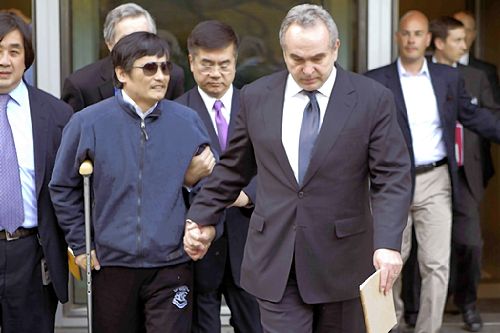
In a photograph made Wednesday by the American Embassy in Beijing, Chinese dissident Chen Guangcheng, left, holds hands with Kurt M. Campbell, assistant secretary of state for East Asian and Pacific Affairs, outside the embassy.
  • In a photograph made Wednesday by the American Embassy in Beijing, Chinese dissident Chen Guangcheng, left, holds hands with Kurt M. Campbell, assistant secretary of state for East Asian and Pacific Affairs, outside the embassy.

Share with others:

BEIJING -- A cloud hung over annual talks between the United States and China on Thursday as a blind Chinese dissident who took refuge in the U.S. Embassy appealed to Washington for more help, saying from his hospital room in Beijing that he now fears for his family's safety unless they are all spirited abroad.
China already demanded an apology from the United States even before Chen Guangcheng balked at a deal in which he would remain in his homeland. Now that he wants to leave, the case could overshadow talks in which Secretary of State Hillary Rodham Clinton and Treasury Secretary Timothy Geithner are to discuss foreign policy and economic issues with their Chinese counterparts.
After six days holed up in the U.S. Embassy, as senior officials in Beijing and Washington tussled over his fate, Mr. Chen left the compound's protective confines Wednesday for a nearby hospital to get treatment of a leg injury suffered in his escape. A shaken Mr. Chen said in an interview from his hospital room that Chinese authorities had warned that he would lose his opportunity to be reunited with his family if he stayed longer in the embassy.
U.S. officials verified that account. But they adamantly denied his contention that one American diplomat had warned him of a threat from the Chinese that his wife would be beaten to death if he did not get out of the embassy.
"I think we'd like to rest in a place outside of China," Mr. Chen said, appealing again for help from Washington. "Help my family and me leave safely."
Only hours earlier, U.S. officials said they had extracted from the Chinese government a promise that Mr. Chen would join his family and be allowed to start a new life in a university town in China, safe from the rural authorities who had abusively held him in prison and house arrest for nearly seven years.
Ms. Clinton spoke to Mr. Chen by phone when he left the embassy and, in a statement, welcomed the resettlement agreement as one that "reflected his choices and our values."
But the murky circumstances of Mr. Chen's departure from the embassy -- and his sudden appeal to leave China after declaring that he wanted to stay -- again threatened to overshadow talks that were to focus on the global economic crisis and hotspots such as North Korea, Iran, Syria and Sudan.
The Chinese Foreign Ministry signaled its unhappiness with the entire affair, demanding that the United States apologize for giving Mr. Chen sanctuary at the embassy. "What the U.S. side should do now is neither to continue misleading the public and making every excuse to shift responsibility and conceal its wrongdoing, nor to interfere in the domestic affairs of China," Chinese Foreign Ministry spokesman Liu Weimin said late Wednesday in a statement in response to Ms. Clinton's comments praising the deal on Mr. Chen.
Mr. Chen, 40, became an international human rights figure and inspiration to many ordinary Chinese after running afoul of local government officials for exposing forced abortions carried out as part of his country's one-child policy. He served four years in prison on what supporters said were fabricated charges, then was kept under house arrest with his wife, daughter and mother. The adults often were roughed up by officials, and his daughter was searched and harassed.
Blinded by childhood fever but intimately familiar with the terrain of his village, Mr. Chen slipped from his guarded farmhouse in eastern China's Shandong province the night of April 22. He made his way through fields and forest, along roads and across a narrow river to meet the first of several supporters who helped bring him to Beijing and the embassy. It took three days for his guards to realize that he was gone.
In Washington, State Department spokesman Mark Toner disputed Mr. Chen's claim that he was left alone at the hospital by the Americans. "There were U.S. officials in the building," the spokesman told reporters. "I believe some of his medical team was, in fact, with him at the hospital." He said U.S. officials would continue visiting Mr. Chen while he was there.
Mr. Chen's U.S. supporters called upon Ms. Clinton to meet him directly, and one, Rep. Christopher Smith, R-N.J., said it appeared that the resettlement agreement "seems to have been done under significant duress." He added, "If ever there was a test of the U.S. commitment to human rights, it should have been at that moment, potentially sending him back to a very real threat."
But no one appeared to know precisely what to make of Mr. Chen's change of heart. He had welcomed a deal that let him stay in China and work for change, telling his lawyer, Li Jinsong, on the way to the hospital: "I'm free. I've received clear assurances," according to the lawyer.
Mr. Toner said three U.S. officials heard Mr. Chen tell Ms. Clinton in broken English on the phone that he wanted to kiss her in gratitude. Mr. Chen said in the AP interview that he actually told Ms. Clinton, "I want to see you now."
Nor is it clear how the United States could be party to an agreement on Mr. Chen's safety inside China when it has no power to enforce the conditions of his life there.
State Department spokeswoman Victoria Nuland said no U.S. official said anything to Mr. Chen about physical or legal threats to his wife and children. Nor did the Chinese relay any such threats to U.S. diplomats, she said. She did confirm that if he did not leave the embassy, the Chinese intended to return his family to their home province of Shandong, where they had been detained and beaten by local officials, and that they would lose any chance of being reunited.
"At every opportunity, he expressed his desire to stay in China, reunify with his family, continue his education and work for reform in his country," Ms. Nuland said. "All our diplomacy was directed at putting him in the best possible position to achieve his objectives."
Jerome Cohen, a New York University law professor who is advising Mr. Chen at the State Department's request, said there was never any explicit discussion of a threat against Mr. Chen's wife.
"There was no indication in four or five hours of talks that he knew of any threat to her life," Mr. Cohen said.
Senior U.S. officials, speaking on condition of anonymity to discuss the intense negotiations that led to Mr. Chen's leaving the embassy, said the United States helped Mr. Chen get into the embassy because he injured his leg escaping from his village.
In the embassy, Mr. Chen did not request safe passage out of China or asylum in the United States, the officials said.
U.S. officials said the deal called for Mr. Chen to settle outside his home province of Shandong and have several university options to choose from. They also said the Beijing government had pledged to treat Mr. Chen "like any other student in China," and to investigate allegations of local authorities' abuse of him and his family.
Ms. Clinton said the United States would monitor China's assurances. "Making these commitments a reality is the next crucial task," she said.