Dissident's status clouding China, U.S. talks
May 3, 2012 12:28 am
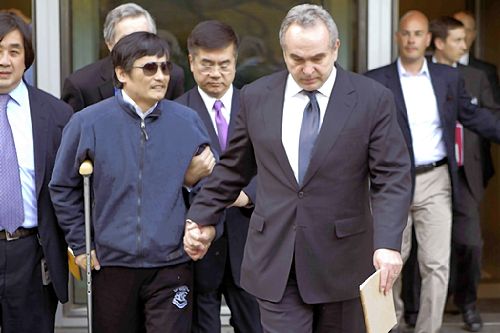
In a photograph made Wednesday by the American Embassy in Beijing, Chinese dissident Chen Guangcheng, left, holds hands with Kurt M. Campbell, assistant secretary of state for East Asian and Pacific Affairs, outside the embassy.

Share with others:

BEIJING -- A cloud hung over annual talks between the United States and China on Thursday as a blind Chinese dissident who took refuge in the U.S. Embassy appealed to Washington for more help, saying from his hospital room in Beijing that he now fears for his family's safety unless they are all spirited abroad.
China already demanded an apology from the United States even before Chen Guangcheng balked at a deal in which he would remain in his homeland. Now that he wants to leave, the case could overshadow talks in which Secretary of State Hillary Rodham Clinton and Treasury Secretary Timothy Geithner are to discuss foreign policy and economic issues with their Chinese counterparts.
After six days holed up in the U.S. Embassy, as senior officials in Beijing and Washington tussled over his fate, Mr. Chen left the compound's protective confines Wednesday for a nearby hospital to get treatment of a leg injury suffered in his escape. A shaken Mr. Chen said in an interview from his hospital room that Chinese authorities had warned that he would lose his opportunity to be reunited with his family if he stayed longer in the embassy.
U.S. officials verified that account. But they adamantly denied his contention that one American diplomat had warned him of a threat from the Chinese that his wife would be beaten to death if he did not get out of the embassy.
"I think we'd like to rest in a place outside of China," Mr. Chen said, appealing again for help from Washington. "Help my family and me leave safely."
Only hours earlier, U.S. officials said they had extracted from the Chinese government a promise that Mr. Chen would join his family and be allowed to start a new life in a university town in China, safe from the rural authorities who had abusively held him in prison and house arrest for nearly seven years.
Ms. Clinton spoke to Mr. Chen by phone when he left the embassy and, in a statement, welcomed the resettlement agreement as one that "reflected his choices and our values."
But the murky circumstances of Mr. Chen's departure from the embassy -- and his sudden appeal to leave China after declaring that he wanted to stay -- again threatened to overshadow talks that were to focus on the global economic crisis and hotspots such as North Korea, Iran, Syria and Sudan.
The Chinese Foreign Ministry signaled its unhappiness with the entire affair, demanding that the United States apologize for giving Mr. Chen sanctuary at the embassy. "What the U.S. side should do now is neither to continue misleading the public and making every excuse to shift responsibility and conceal its wrongdoing, nor to interfere in the domestic affairs of China," Chinese Foreign Ministry spokesman Liu Weimin said late Wednesday in a statement in response to Ms. Clinton's comments praising the deal on Mr. Chen.
Mr. Chen, 40, became an international human rights figure and inspiration to many ordinary Chinese after running afoul of local government officials for exposing forced abortions carried out as part of his country's one-child policy. He served four years in prison on what supporters said were fabricated charges, then was kept under house arrest with his wife, daughter and mother. The adults often were roughed up by officials, and his daughter was searched and harassed.
Blinded by childhood fever but intimately familiar with the terrain of his village, Mr. Chen slipped from his guarded farmhouse in eastern China's Shandong province the night of April 22. He made his way through fields and forest, along roads and across a narrow river to meet the first of several supporters who helped bring him to Beijing and the embassy. It took three days for his guards to realize that he was gone.
In Washington, State Department spokesman Mark Toner disputed Mr. Chen's claim that he was left alone at the hospital by the Americans. "There were U.S. officials in the building," the spokesman told reporters. "I believe some of his medical team was, in fact, with him at the hospital." He said U.S. officials would continue visiting Mr. Chen while he was there.
Mr. Chen's U.S. supporters called upon Ms. Clinton to meet him directly, and one, Rep. Christopher Smith, R-N.J., said it appeared that the resettlement agreement "seems to have been done under significant duress." He added, "If ever there was a test of the U.S. commitment to human rights, it should have been at that moment, potentially sending him back to a very real threat."
But no one appeared to know precisely what to make of Mr. Chen's change of heart. He had welcomed a deal that let him stay in China and work for change, telling his lawyer, Li Jinsong, on the way to the hospital: "I'm free. I've received clear assurances," according to the lawyer.
Mr. Toner said three U.S. officials heard Mr. Chen tell Ms. Clinton in broken English on the phone that he wanted to kiss her in gratitude. Mr. Chen said in the AP interview that he actually told Ms. Clinton, "I want to see you now."
Nor is it clear how the United States could be party to an agreement on Mr. Chen's safety inside China when it has no power to enforce the conditions of his life there.
State Department spokeswoman Victoria Nuland said no U.S. official said anything to Mr. Chen about physical or legal threats to his wife and children. Nor did the Chinese relay any such threats to U.S. diplomats, she said. She did confirm that if he did not leave the embassy, the Chinese intended to return his family to their home province of Shandong, where they had been detained and beaten by local officials, and that they would lose any chance of being reunited.
"At every opportunity, he expressed his desire to stay in China, reunify with his family, continue his education and work for reform in his country," Ms. Nuland said. "All our diplomacy was directed at putting him in the best possible position to achieve his objectives."
Jerome Cohen, a New York University law professor who is advising Mr. Chen at the State Department's request, said there was never any explicit discussion of a threat against Mr. Chen's wife.
"There was no indication in four or five hours of talks that he knew of any threat to her life," Mr. Cohen said.
Senior U.S. officials, speaking on condition of anonymity to discuss the intense negotiations that led to Mr. Chen's leaving the embassy, said the United States helped Mr. Chen get into the embassy because he injured his leg escaping from his village.
In the embassy, Mr. Chen did not request safe passage out of China or asylum in the United States, the officials said.
U.S. officials said the deal called for Mr. Chen to settle outside his home province of Shandong and have several university options to choose from. They also said the Beijing government had pledged to treat Mr. Chen "like any other student in China," and to investigate allegations of local authorities' abuse of him and his family.
Ms. Clinton said the United States would monitor China's assurances. "Making these commitments a reality is the next crucial task," she said.



No comments:
Post a Comment